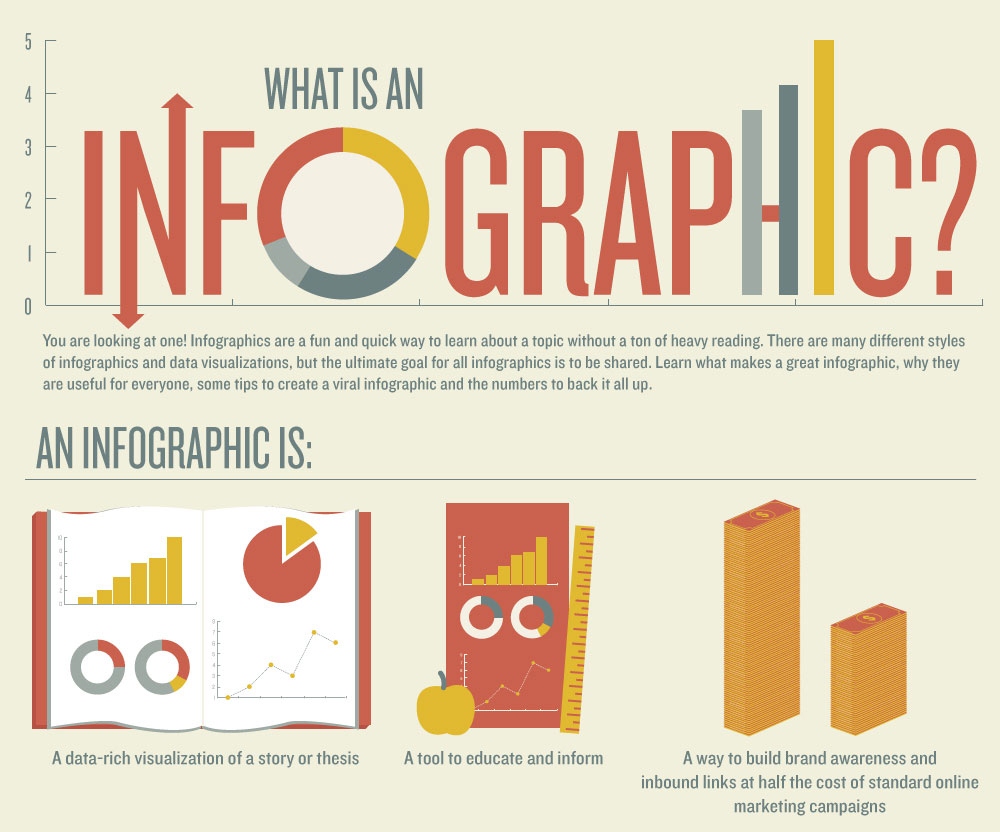
In this new technology age that is steady growing more and more advanced, there are numerous ways to present information and material to different types of audiences. In my elementary, middle, and high school years of school, making a video or a powerpoint were the most popular ways to display a presentation to one's peers/classmates, teachers/professors, and colleagues. Although I am and will always be Powerpoint presentation fanatic (simply because this is what I grew up making), I am excited to discover and learn about the rise in infographics for not only today's students in the classroom, but for all people in need of a presentation to be presented to a certain audience. According to Hicks and Turner (2017), the definition of infographics are graphic visual representations of information, data or knowledge intended to present complex information quickly and clearly (p. 60). To be more specific in using simplistic terms, infographics are simply another method of presenting one's argument on a subject or topic in using graphic visual aides. Due to so much emphasis being placed on the importance of teaching digital arguments to our students, it is also of the same importance that we expose our students to infographics so that they may more effectively argue and prove their claim about a side of an argument by using the necessary graphic visual representation for support. In this short video, we see in greater detail why infographics are so important today and the benefits that they give our students in the classroom as well as adults in the workplace.
As educators, we should also find infographics to be very helpful in our instruction in that they are a great teaching tool to utilize for our students since the information in broken down for easier understanding. In just my short year and 7 months of teaching, I have learned that all students learn in different ways, but having a visual aid or model is helpful to all students because it allows for students to make that necessary connection from the visual aid to the concept being taught. According to the website article, Why Infographics Are So Effective in Educational Contexts, "Infographics prove effective in educational contexts because they use imagery to highlight, explain, or enhance text-based information" as well as. "has the unique ability to capture attention and convey information." (Copypress, n.d.). With teaching kindergarten last school year and now fifth grade this year, both grades have 1 big thing in common- it is so difficult and tiresome to keep them engaged at all times! Both kindergarteners and fifth graders are wiggle worms and love to move around, so utilizing infographics in the classroom in a great tool to use in the classroom to capture and maintain the attention of my students.
Not only should we incorporate infographics in our classrooms during our instructional time, but we should also allow our students the opportunity to become familiar with as well as practice with utilizing infographics on their own time in class. Having a student to create their own infographic on a topic is a great way for teachers to assess students on how well they comprehend their information on their topic as well as grasped the content well enough to make a visual representation to teach someone else. According to Hicks and Turner (2017), "...we realize that creating infographics allows students to engage in inquiry in interesting ways" (p. 74). The older and more mature that our students become, then the more questions they start to ask about different things. In the classroom, inquiry is an extremely good thing for our students to possess because this means that they are interested in the material that they are learning and are yearning to learn more by asking questions and hopefully to eventually do research on their subject. Students engaging in more inquiry also means that they are having to practice the skill of researching and discovering text evidence that can accurately back up their claim in order to prove their point. In my own classroom of fifth graders, text evidence and supporting details are two of the biggest skills that we stress daily and struggle with! So, I find it extremely encouraging to know that through the usage of infographics in the classroom, inquiry increases which will lead to students getting better at finding text evidence and supporting details to support their answers and claims.
This Google Slides presentation breaks down just a mere few of the reason why utilizing infographics is beneficial to students and educators!
References:
Neppes, R. (2018, April 4). The Rise of Infographics in Public Relations and Journalism. Retrieved from https://buchananpr.com/2015/12/the-rise-of-infographics-in-public-relations-and-journalism
The Benefits of Infographics for Education - Content Marketing Agency: Content Marketing Services by CopyPress. (n.d.). Retrieved from https://www.copypress.com/kb/infographics/the-benefits-of-infographics-for-education/
Turner, K., & Hicks, T. (2017) Argument in the real world: Teaching adolescents to read and write digital texts Portsmouth, NH: Heinemann.

Yarbrough (2019), described infographics as "one of the many visual learning tools available to support learning and retention." I agree with you that our students must absolutely have opportunities to read and create infographics. You were right in saying that if the child can make an infographic than they definitely have a solid understanding, especially since they are teaching someone about their information.
ReplyDeleteI am seeing more and more curriculum resources including infographics and other visual information story telling. Turner and Hicks (2017) suggested that "Perhaps because of their visual appeal, perhaps because they are so easy to "like," "retweet," or "pin," infographics are a steady part of the content readers consume online." Since our students are digital natives and constantly consuming the infographics almost everywhere they turn, it's important for schools to start exposing and educating our students about them.
References
Turner, K., & Hicks, T. (2017) Argument in the real world: Teaching
adolescents to read and write digital texts Portsmouth, NH:
Heinemann.
Yarbrough, J. R. (2019). Infographics: In Support of Online Visual
Learning. Academy of Educational Leadership Journal, 2.
I agree that we should not only use infographics in the classroom but also have students create infographics of their own. Turner and Hicks (2017) state that "we want them to read and write the arguments that infographics present to the world" (p.80). As a 1st grade teacher, I know students are not short on arguments. However, they are short on ways to back up their arguments. Just last week, I had asked my students if they believed if the wolf meant to blow down the three pigs' houses or if it was an accident. Most of my students thought he did it on accident, but only one student was able to come up with a reason. Having students create infographics would require students to think hard about the argument that they would be forming and produce evidence to back said claim. So, I do agree that teachers can and should use infographics in the classroom, both instructional and as means to asses, no matter the grade. So long as students are learning, we should use any means available for use, even infographics.
ReplyDeleteReference
Turner, K., & Hicks, T. (2017) Argument in the real world: Teaching adolescents to
read and write digital texts Portsmouth, NH: Heinemann.
I completely agree that infographics are a great way to engage students in the classroom. Like you, I have also been looking for ways to deepen my students' thoughts about topics and find something that interest them in the learning process. Tuner and Hicks (2017) states," Rather than seeing the information as simply data, commenters quickly absorbed the information and began drawing comparisons to their own lives" (p. 61). In kindergarten, one of our standards in reading deals with students being able to draw personal connections to text. This can be difficult for them to accomplish with reading traditional text or having traditional text read to them, simply because kindergartners, as you know, have a short attention span. It can be tough to keep their attention long enough to have them make those personal connections. However, Infographics would be a great way to allow students to make those personal connections in a quick fashion. I completely agree infographics could be a great tool to utilize in the classroom! As the technology world keeps growing, it is a great idea for educators to continue to utilize the items available to us to help our students grow in any way possible.
ReplyDeleteReference
Turner, K., & Hicks, T. (2017) Argument in the real world: Teaching adolescents to read and write digital text. Portsmouth, NH: Heinemann.
Great post, Jasmine! I share the same intimate in that I grew up with Word Powerpoint. It's comfortable and consistent. Google Slides offers the same consistency while offering the benefits of the cloud. Hallelujah for the cloud! If teachers are going to advance and learn with our students, we have to get out of our comfort zones, though, to keep up with them. Although there's a lot of time spent creating them, infographics are a quick tool for others to clearly see an argument and the facts that go with it. In paragraph three, you said that the infographics could be used "to assess students on how well they comprehend their information on their topic." That is a great, hands-on informal assessment and such powerful information, too! Troy Hicks (2017) even says that "creating infographics allows students to engage in inquiry in interesting ways." (p.74) As I a parent, I appreciate your willingness to let the students explore subjects that interest them. The students are more willing and more excited to grow their knowledge in these areas even if you are holding the reins and guiding their learning.
ReplyDelete